Performing simulations#
How does the simulator work?#
The simulator is a class that allows previously designed experiments to be executed. To run it, we need a network (multilayer or temporal; it may have single layer as well) and a corresponding model. After the experiment is completed, the user can view the results as a report and a visualisation of the actor states.
The following example considers a custom SIR~UA model: the spread of two processes in separate layers that are dependent on each other. * “contagion” process with states S (suspected), I (infected), R (removed), * “awareness” process with states U (unaware), A (aware). The possible transitions can be described by the following graph:
S·U---->I·U---->R·U
 |       |       |
 |       |       |
 v       v       v
S·A---->I·A---->R·A
All transitions except I->R are determined by interactions between neighbouring nodes. Nodes can transition from I to R without any external stimuli. The constructor parameters are probabilities of transitions and the initial percentages of infected and aware nodes.
Example of usage#
Import necessary libraries
import networkx as nx
import network_diffusion as nd
import numpy as np

from network_diffusion.models import (
    BaseModel,
    CompartmentalGraph,
    NetworkUpdateBuffer,
)
Create the propagation model
  1class SIR_UAModel(BaseModel):
  2
  3    def __init__(
  4        self,
  5        alpha: float,
  6        alpha_prime: float,
  7        beta: float,
  8        gamma: float,
  9        delta: float,
 10        ill_seeds: float,
 11        aware_seeds: float,
 12    ) -> None:
 13        """
 14        An SIR~UA model.
 15
 16        :param alpha: probability weight of S->I for unaware nodes
 17        :param alpha_prime: prob. of S->I for aware nodes
 18        :param beta: prob. of I->R for both unaware and aware nodes
 19        :param gamma: prob. of U->A for both suspected and removed nodes
 20        :param delta: prob. of U->A for ill nodes
 21        :param ill_seeds: % of initially I nodes
 22        :param aware_seeds: % of initially A nodes
 23        """
 24        compartments = self._create_compartments(
 25            alpha=alpha,
 26            alpha_prime=alpha_prime,
 27            beta=beta,
 28            gamma=gamma,
 29            delta=delta,
 30            ill_seeds=ill_seeds,
 31            aware_seeds=aware_seeds,
 32        )
 33        self.__comp_graph = compartments
 34        self.__seed_selector = nd.seeding.RandomSeedSelector()
 35
 36    @staticmethod
 37    def _create_compartments(
 38        alpha: float,
 39        alpha_prime: float,
 40        beta: float,
 41        gamma: float,
 42        delta: float,
 43        ill_seeds: float,
 44        aware_seeds: float,
 45    ) -> CompartmentalGraph:
 46        # define processes, allowed states and initial percentages of actors in those states
 47        phenomena: dict[str, tuple] = {
 48            "contagion": (["S", "I", "R"], [100 - ill_seeds, ill_seeds, 0]),
 49            "awareness": (["U", "A"], [100 - aware_seeds, aware_seeds]),
 50        }
 51
 52        # wrap them into compartments
 53        cg = CompartmentalGraph()
 54        for phenomenon, (states, budget) in phenomena.items():
 55            cg.add(process_name=phenomenon, states=states)  # name of process
 56            cg.seeding_budget.update({phenomenon: budget})  # initial %s
 57        cg.compile(background_weight=0)
 58
 59        # set up weights of transitions for SIR and unaware
 60        cg.set_transition_fast(
 61            "contagion.S", "contagion.I", ("awareness.U",), alpha
 62        )
 63        cg.set_transition_fast(
 64            "contagion.I", "contagion.R", ("awareness.U",), beta
 65        )
 66
 67        # set up weights of transitions for SIR and aware
 68        cg.set_transition_fast(
 69            "contagion.S", "contagion.I", ("awareness.A",), alpha_prime
 70        )
 71        cg.set_transition_fast(
 72            "contagion.I", "contagion.R", ("awareness.A",), beta
 73        )
 74
 75        # set up weights of transitions for UA and suspected
 76        cg.set_transition_fast(
 77            "awareness.U", "awareness.A", ("contagion.S",), gamma
 78        )
 79
 80        # set up weights of transitions for UA and infected
 81        cg.set_transition_fast(
 82            "awareness.U", "awareness.A", ("contagion.I",), delta
 83        )
 84
 85        # set up weights of transitions for UA and removed
 86        cg.set_transition_fast(
 87            "awareness.U", "awareness.A", ("contagion.R",), gamma
 88        )
 89
 90        return cg
 91
 92    @property
 93    def _compartmental_graph(self) -> CompartmentalGraph:
 94        """Compartmental model that defines allowed transitions and states."""
 95        return self.__comp_graph
 96
 97    @property
 98    def _seed_selector(self) -> nd.seeding.RandomSeedSelector:
 99        """A method of selecting seed agents."""
100        return self.__seed_selector
101
102    def __str__(self) -> str:
103        descr = f"{nd.utils.BOLD_UNDERLINE}\n"
104        descr += f"SIR-UA Model\n"
105        descr += self._compartmental_graph.__str__()
106        descr += str(self._seed_selector)
107        return descr
108
109    def determine_initial_states(
110        self, net: nd.MultilayerNetwork
111    ) -> list[NetworkUpdateBuffer]:
112        if not net.is_multiplex():
113            raise ValueError("This model works only with multiplex networks!")
114
115        budget = self._compartmental_graph.get_seeding_budget_for_network(net)
116        nodes_ranking = self._seed_selector.nodewise(net)
117        initial_states = []
118
119        # set initial states in contagion process/layer
120        for node_position, node_id in enumerate(nodes_ranking["contagion"]):
121            if node_position < budget["contagion"]["I"]:
122                node_initial_state = "I"
123            else:
124                node_initial_state = "S"
125            initial_states.append(
126                nd.models.NetworkUpdateBuffer(
127                    node_id, "contagion", node_initial_state
128                )
129            )
130
131        # set initial states in awareness process/layer
132        for node_position, node_id in enumerate(nodes_ranking["awareness"]):
133            if node_position < budget["awareness"]["A"]:
134                node_initial_state = "A"
135            else:
136                node_initial_state = "U"
137            initial_states.append(
138                nd.models.NetworkUpdateBuffer(
139                    node_id, "awareness", node_initial_state
140                )
141            )
142
143        return initial_states
144
145    @staticmethod
146    def flip_a_coin(prob_success: float) -> bool:
147        result = np.random.choice([0, 1], p=[1 - prob_success, prob_success])
148        if result == 1:
149            return True
150        return False
151
152    def agent_evaluation_step(
153        self, agent: int, layer_name: str, net: nd.MultilayerNetwork
154    ) -> str:
155        layer_graph: nx.Graph = net[layer_name]
156
157        # Get possible transitions for the node's state
158        current_state = layer_graph.nodes[agent]["status"]
159        transitions = self._compartmental_graph.get_possible_transitions(
160            net.get_actor(agent).states_as_compartmental_graph(), layer_name
161        )
162
163        # If there is no possible transition, return current state
164        if len(transitions) == 0:
165            return current_state
166
167        # If transition does not depend on interactions with neighbours (i.e. I->R)
168        if layer_name == "contagion" and current_state == "I":
169            new_state = "R"
170            if self.flip_a_coin(transitions[new_state]):
171                return new_state
172
173        # Otherwise iterate through neighbours
174        else:
175            for neighbour in nx.neighbors(layer_graph, agent):
176                new_state = layer_graph.nodes[neighbour]["status"]
177                if new_state in transitions and self.flip_a_coin(
178                    transitions[new_state]
179                ):
180                    return new_state
181
182        return current_state
183
184    def network_evaluation_step(
185        self, net: nd.MultilayerNetwork
186    ) -> list[NetworkUpdateBuffer]:
187        new_states = []
188        for layer_name, layer_graph in net.layers.items():
189            for node in layer_graph.nodes():
190                new_state = self.agent_evaluation_step(node, layer_name, net)
191                layer_graph.nodes[node]["status"] = new_state
192                new_states.append(
193                    nd.models.NetworkUpdateBuffer(node, layer_name, new_state)
194                )
195        return new_states
196
197    def get_allowed_states(
198        self, net: nd.MultilayerNetwork
199    ) -> dict[str, tuple[str, ...]]:
200        return self._compartmental_graph.get_compartments()
Load the network
net = nd.MultilayerNetwork.from_nx_layer(
    nx.karate_club_graph(), ["contagion", "awareness"]
)
print(net)
============================================
network parameters
--------------------------------------------
general parameters:
        number of layers: 2
        number of actors: 34
        number of nodes: 68
        number of edges: 156

layer 'contagion' parameters:
        graph type - <class 'networkx.classes.graph.Graph'>
        number of nodes - 34
        number of edges - 78
        average degree - 4.5882
        clustering coefficient - 0.5706

layer 'awareness' parameters:
        graph type - <class 'networkx.classes.graph.Graph'>
        number of nodes - 34
        number of edges - 78
        average degree - 4.5882
        clustering coefficient - 0.5706
============================================
Initialise an instance of the propagation model
model = SIR_UAModel(
    alpha=0.19,
    alpha_prime=0.0665,
    beta=0.1,
    gamma=0.01,
    delta=0.71,
    ill_seeds=5,
    aware_seeds=5,
)
print(model)
============================================
SIR-UA Model
============================================
compartmental model
--------------------------------------------
processes, their states and initial sizes:
        'contagion': [S:95%, I:5%, R:0%]
        'awareness': [U:95%, A:5%]
--------------------------------------------
process 'contagion' transitions with nonzero weight:
        from S to I with probability 0.19 and constrains ['awareness.U']
        from I to R with probability 0.1 and constrains ['awareness.U']
        from S to I with probability 0.0665 and constrains ['awareness.A']
        from I to R with probability 0.1 and constrains ['awareness.A']
--------------------------------------------
process 'awareness' transitions with nonzero weight:
        from U to A with probability 0.01 and constrains ['contagion.S']
        from U to A with probability 0.71 and constrains ['contagion.I']
        from U to A with probability 0.01 and constrains ['contagion.R']
============================================
============================================
seed selection method
--------------------------------------------
        nodewise random choice
============================================
Perform the simulation
experiment = nd.Simulator(model, net)
run_logs = experiment.perform_propagation(n_epochs=10)
Save experiment results. User is able to save them to the file or print them out
run_logs.report(path="results", visualisation=True)
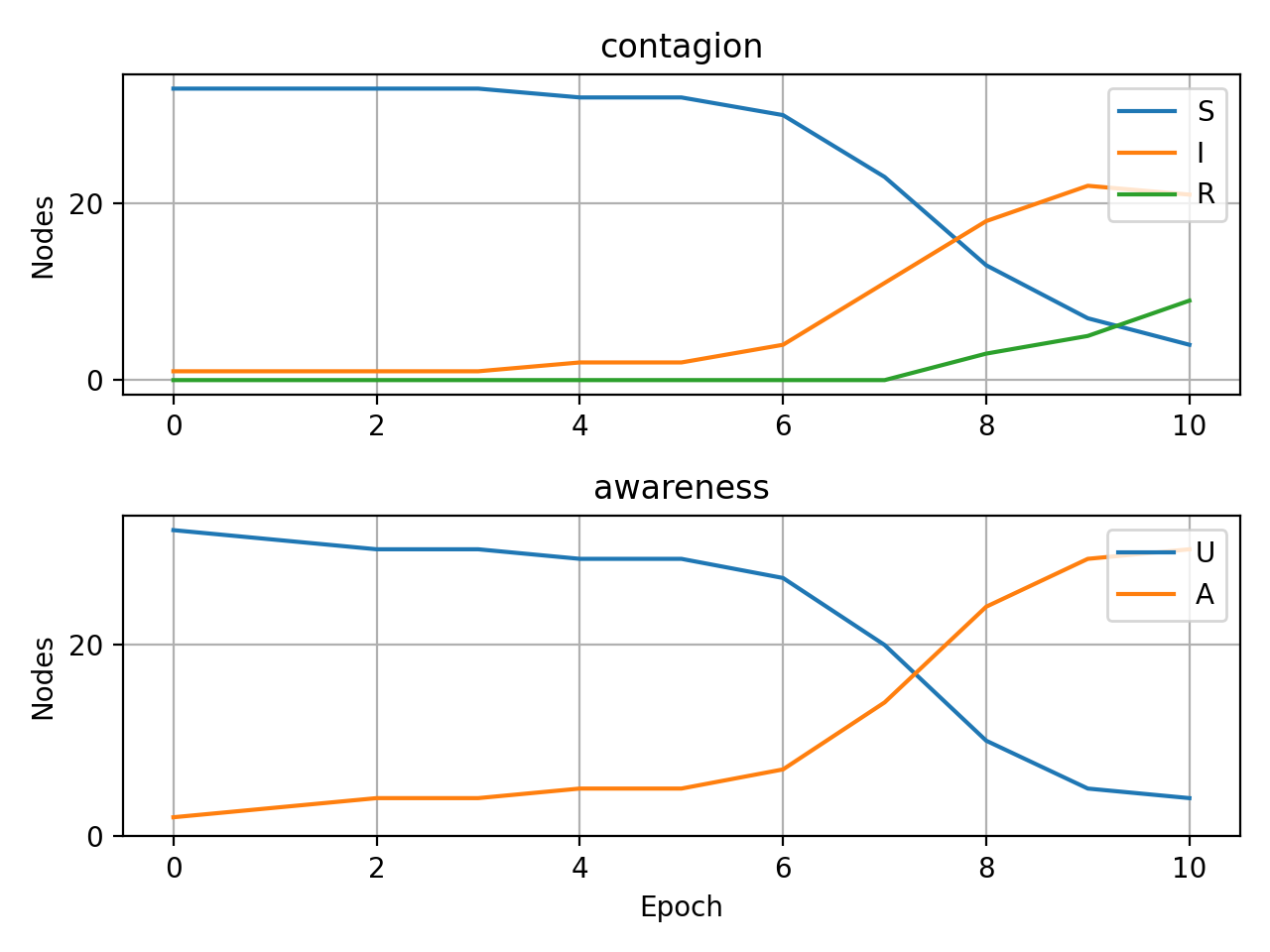
The logs contain: * a description of the network (txt file), * a description of the propagation model (txt file), * a report of the spreading for all simulated phenomena (separate csv files), * a capture of states of every single node at the end of each simulation step (JSON file), * a brief visualisation of propagation.
If you need to process the results directly in Python, you can extract them with two functions. For aggregated results for each process
run_logs.get_aggragated_logs()
or for detailed logs concerning all nodes.
run_logs.get_detailed_logs()